
Global Implementation Science Seminar Series
The GISL strives to be the focal point for implementation science research globally. The GISL contributes to the body of knowledge in implementation science with applications that address important health policy issues, especially in low- and middle-income countries. The seminar series is our key forum for knowledge sharing, training, and networking.
The GISL Seminar Series creates space and engagement in meaningful conversations about implementation science research, practice, and challenges across faculties and students working on implementation science. Our goal is to expand, explore, and extract knowledge and skills, and to connect students with researchers and practitioners working on current issues.
The series runs randomly, featuring outstanding speakers and leading-edge topics. Everyone is welcome to attend! To ensure everyone can access the presentations, each session will be broadcast via Zoom and recorded for viewing on this site. Please visit this page for updates to the schedule and topics. Zoom recordings of the presentations will be added to this page following each presentation.
Upcoming Seminars
October 11th 2024, 12-1pm, Health Science Building Room 507 | Understanding the Practices and Perceptions of Chinese Elderly towards Vaccination in the Context of COVID-19: A Qualitative Study in Anhui Province | Dr. Li Wang from Anhui Medical University, China | Zoom access: https://utoronto.zoom.us/j/82285128271

Senior citizens are at a higher risk of contracting vaccine-preventable diseases (VPDs) due to age-related changes in their immune systems and increased exposure to infectious agents. Vaccinations can help the elderly reduce the risk of VPDs, as well as complications, hospitalizations, and death. Globally, the vaccination rate among rural elderly populations is generally lower than that in urban areas. The present study aims to explore and understand the practices and perceptions of Chinese elderly in rural areas towards vaccination in the context of COVID-19. Four graduate students from the School of Health Services Management, at Anhui Medical University (AMU), recruited a total of 13 older adults aged 60 years or older from their hometown villages and conducted two rounds of in-depth qualitative interviews. The focus was on influenza, pneumococcal, and COVID-19 vaccines, particularly in the context of the COVID-19 pandemic. To avoid being constrained by a purely public health theoretical framework, the qualitative interviews incorporated a sociological perspective. Qualitative data were analyzed using grounded theory and an attempt was made to construct the conceptual frameworks.
Li Wang(ligrace.wang@utoronto.ca) is an Associate Professor at the School of Health Services Management, Anhui Medical University, China, and is currently a Visiting Professor at the Dalla Lana School of Public Health (DLSPH), University of Toronto, under the supervision of Professor Xiaolin Wei, a public health specialist and professor at DLSPH. In recent years, Li Wang is mainly focusing on research about vaccine hesitancy, and has around 20 peer-reviewed publications in this field.
September 12th 2024, 12-1pm, Health Science Building Room 650 | Applying RNA-based technology to diagnose and monitor treatment of latent- and active- tuberculosis | Dr. Wilber Sabiiti from the University of St Andrews | Zoom access: https://utoronto.zoom.us/j/89401215110
Nearly 30000 people fall ill and over 4000 die of tuberculosis (TB) every day (UNAIDS factsheet). A quarter of the world population are latently infected with TB making a large reservoir of people at risk of developing active (symptomatic) TB disease. Treatment is long, taking a minimum of six months for drug susceptible TB and 9 months for drug resistant TB, yet standard-of-care treatment monitoring tools are ineffective. Taking advantage of abundant ribosomal RNA in the bacterial cell, we developed the tuberculosis Molecular Bacterial Load Assay (TB-MBLA) test which detects and quantifies live TB bacteria in patient specimens giving a result in 4h. The live TB bacillary load count of patients responding positively to therapy declines over the course of treatment and can be detected as early as 3 days from initiation of treatment. Using TB-MBLA we have shown that a good proportion of TB patients clear sputum bacillary load to zero by week 2 and remain negative throughout 6 months of treatment, increasing hopes of personalised- and shorter- treatment regimens. We applied the same assay to cattle specimens and found over 40% had live TB in their livers and lungs just before the meat was sold off for food in Nigeria. This means control of human TB may not succeed without control of TB in animals. Apart from active TB, we have exploited the idea of human genes that are expressed specifically in response to TB infection to develop a diagnostic that distinguishes latently infected from healthy individuals. Clinical evaluation in Malawi has shown our diagnostic is more sensitive than the standard-of-care interferon gamma release assay (IGRA). We believe our latent TB diagnostic will provide an efficient tool to guide appropriate administration of TB preventive therapy globally.

Dr Sabiiti is Principal Research Fellow in Medicine (Associate Professor) in the Division of Infection and Global Health, School of Medicine, University of St Andrews, UK. He leads translational research on diagnostic and treatment biomarkers for infectious diseases. His group was the first to develop an RNA-based molecular diagnostic to measure live TB bacteria and monitor treatment response. He is a Principal Investigator of the St Andrews-Africa Health Research network (StAAHR), Co-Chair of the Coalition for Equitable Research in Low Resource Settings (CERCLE) Immunology and Diagnostics Expert Working Group and Co-Chief Investigator of the Africa Vaccine Research Network (AFRIVAXn). He leads translational research initiatives between all regions of Africa and the United Kingdom.
April 10th 2024, 12-1:30pm, Health Science Building Room 507 | What determinants affect inpatient satisfaction in a US-based post-acute care rehabilitation hospital? | Dr. Jasper Xu from the University of North Floria | Zoom access: https://utoronto.zoom.us/j/87414270460
The study investigated the determinants affecting inpatient satisfaction in a US-based post-acute care rehabilitation hospital, focusing on how various hospital service domains influence patient satisfaction, the overall quality of care, and patients’ willingness to recommend the hospital. It utilized patient-level data from electronic medical records and Press Ganey satisfaction data, analyzing responses from 4,785 patients. The research found that personal issues domain was the most significant factor affecting patient satisfaction, followed by domains related to physical therapy, nursing, discharge, and food services. This study provides insights into improving patient experience by prioritizing areas needing enhancement, especially in communication and service delivery within rehabilitation settings.
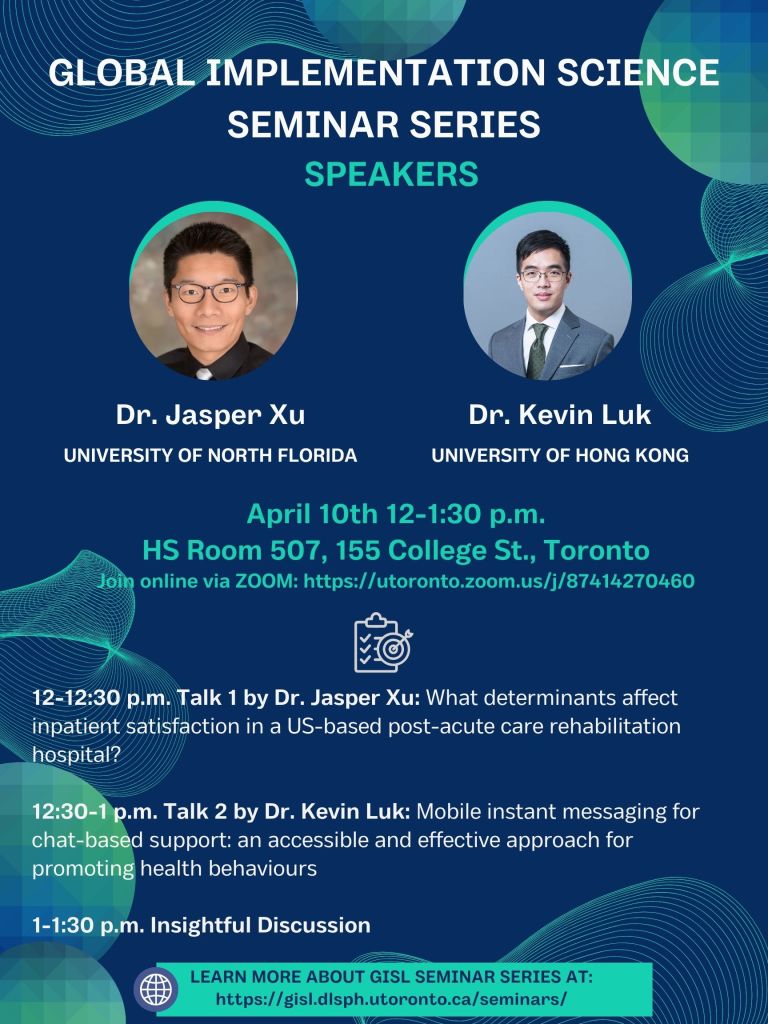

April 10th 2024, 12-1:30pm, Health Science Building Room 507 | Mobile instant messaging for chat-based support: an accessible and effective approach for promoting health behaviours | Dr. Kevin Luk from the University of Hong Kong | Zoom access: https://utoronto.zoom.us/j/87414270460
The potential of digital health interventions to address the burden of unhealthy lifestyles has been hindered by low user engagement. In this seminar, Dr Luk will introduce a chat-based intervention model that leverages mobile instant messaging to overcome some engagement barriers. He will share his research journey in developing and evaluating the model for promoting smoking cessation. Dr Luk will also discuss his recent efforts in implementing and adapting the chat-based approach to address other health behaviours.

Contact Information
For general questions, please email zhitong.zhang@utoronto.ca.
For research questions, please contact our partners directly, or email Prof. Xiaolin Wei.
Global Implementation Science Lab
Dalla Lana School of Public Health
Health Science Building
582-155 College Street
Toronto, ON
M5T 3M7
Canada
 Global Implementation Science Lab